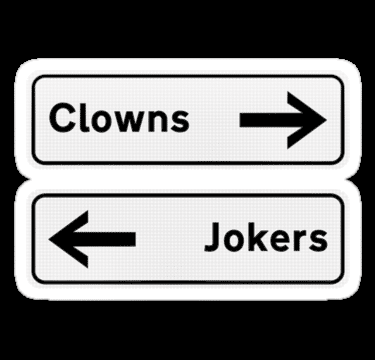
“Clowns to the left of me, Jokers to the right, Here I am, stuck in the middle with you…”- Gerry Rafferty and Joe Egan (Stealers Wheel, 1972), not Bob Dylan.
ALL of the companies I am working with have the same challenge: their leaders are over-extended, and their managers are a bit unprepared for the role they play. Here are four of the most common scenarios:
- Entry level staff is hard to attract. The industry must hire attitude. So, the field is less experienced and over-confident. Keeping them engaged is difficult, because the work is difficult.
- Foremen and Superintendents are promoted early, because the crews in the field need leaders. The best worker is usually promoted, so productivity suffers.
- Project managers are given larger or more jobs to manage because they have the work but not the experience. These are smart, capable people. They manage risk as best they can. If a risk is a problem that has not happened yet, then they do not know what they do not know. So, ironically, a “green” project manager represents a significant risk. [It is not easy being green – Kermit the Frog]

- Finally, the “senior” and most experienced staff is ready to retire but cannot or will not. They are busy doing work and must “pick their battles.” They just do not have the time to develop their direct reports. Their reflex is to micro-manage, which limits growth and organizational development. Their engagement with their people is diminished.
At every level, leaders and managers are less ready and more distracted. As a result, managers and direct reports are less prepared than they should be. So, everyone is “stuck in the middle,” feeling uncovered and unsupported. Or, perhaps, you are the clown or the joker. Let us look at the problems and consider some solutions.
Problem #1: The Pressure to Promote
There is an overwhelming tendency to promote employees into leadership and management roles prematurely. Companies have gaps up and down their organizational charts. Experienced leaders are retiring or shopping out, so organizations feel compelled to fill the voids quickly. The result? Talented, but unseasoned, people are thrust into roles without the necessary time to develop the skills, strategic thinking, and emotional intelligence required to lead effectively.
This phenomenon has a structural root. Many organizations lack robust succession planning and leadership development programs. Instead of cultivating a pipeline of ready leaders, they rely on reactive promotions, often based on technical performance rather than leadership potential. Or they are promoting people to keep them. The consequences are insufficient decision-making, inferior project performance, increased risk exposure, and a loss of organizational capability.
Problem #2: Overwhelmed at the Senior Level
We also have senior leaders who have weathered decades of change, disruption, and transformation. They have “paid their dues” and have lots of experience. They are also facing burnout, yet feel unable, or are unwilling, to retire or step aside. Some of these leaders stay because they fear leaving the organization in unprepared hands (there might be a financial incentive to ensure their retirement). Others stick around because their identity is deeply tied to their role. A few feel a sense of duty to guide the company through the “next few years,” but it is taking longer than they expected.
However, the lingering presence of these overwhelmed and distracted senior leaders can create bottlenecks. Decision-making is delayed, innovation stalls (“this is the way we have always done it”), and younger leaders do not have a place to advance. The result is a leadership culture that tends to micro-manage, forces hierarchy, and is quickly becoming out of sync with the needs of our emerging workforce.
Problem #3: A Shrinking, Shifting Workforce
The demographics of the labor pool have shifted. The workforce is not only shrinking due to aging populations and declining birth rates, but it is also changing in composition. Younger workers entering the labor force often bring different expectations, values, and work styles. They prioritize flexibility, purpose, and continuous learning over traditional career ladders and long-term loyalty, especially challenging in the construction industry.

While this new generation brings fresh energy and digital fluency, they also require more guidance and support than previous cohorts. They also want to be a part of something more socially relevant. Without experienced leaders/mentors and more structured development, they risk becoming overwhelmed, disillusioned, and disengaged. The gap between what they need and what organizations can provide is widening, creating a retention challenge and a lumpy leadership pipeline.
Problem #4: The Middle Management Squeeze
Caught between these two extremes is middle management; a layer that is increasingly burdened with translating strategy into action, managing up and down, and holding teams together amid uncertainty. These managers are often under-resourced, under-trained, and under-appreciated. They are expected to lead change without having a seat at the table where decisions are made and they are really busy; personally, and professionally.
Middle managers are the ones most affected by a leadership vacuum. They must compensate for the inexperience of their junior colleagues while navigating their inattentive senior leadership. This “squeeze” leads to elevated levels of stress, burnout, mistakes, and turnover. The “middle” has fewer people, and there are more “clowns” and “jokers” than ever.
Some Solutions: What Can We Do
To address this dilemma, organizations must take a proactive, strategic approach. Here are five key actions that can help:
- Invest in Leadership Development Early and Often
Leadership is not an innate trait—it is a skill that must be cultivated. Organizations need to identify high-potential employees early and provide them with structured development opportunities, including mentorship, coaching, and strategic assignments. - Redefine Succession Planning
Succession planning should be a dynamic, ongoing process—not a one-time event. It must include clear criteria for readiness, diverse talent pools, and contingency plans for unexpected departures. It should also include some incentives to keep the best and brightest engaged. - Support Senior Leaders in Transition
Rather than waiting for burnout or abrupt exits, organizations should create pathways for senior leaders to transition into advisory or mentoring roles. This allows them to share their wisdom while making room for new leadership. Something as simple as moving them to a three-day work week can help (with a reduced salary, of course). - Empower Middle Managers
Middle managers need more than just responsibility—they need authority, resources, and recognition. Empowering them to make better decisions and supporting their development can strengthen the entire organization. They especially need help learning how to develop their junior staff and will require faster access to “senior” perspective. They should be given flexible work hours and “work from home” permission. Companies that support work and life balance will be more able to keep these managers healthy and engaged. - Adapt to the Workforce Reality
Organizations that are intentional about creating a healthy culture with clear mission are more likely to be chosen by a discerning workforce. Firms that implement effective systems and processes will be able to accelerate the contribution of the newest, least experienced worker. Also, the best companies are providing ongoing development opportunities that align with the leadership goals of younger workers; embracing flexibility and creativity, fostering inclusion, and creating a learning environment.
A Summary and A Call to Action
Our leadership and management challenges are not insurmountable, but they do require some immediate attention. There are a lot of people that feel “stuck in the middle.” They need some help before they get squeezed too hard. That is not just a metaphor, as it turns out, it is a real and pressing (pardon the pun) issue that affects performance, culture, long-term engagement, and organizational health.
By acknowledging the problems and investing in the above solutions, organizations can enhance their resiliency, become more scalable, increase operational effectiveness, and increase profitability. I encourage you to act, soon, or the “clowns” and “jokers” will not be any fun.